
01
Applications
- Port and industrial crane ropes
- Elevator and lift ropes
- Cableway and ropeway installations
- Mine and shaft hoisting ropes
Technical inspection record
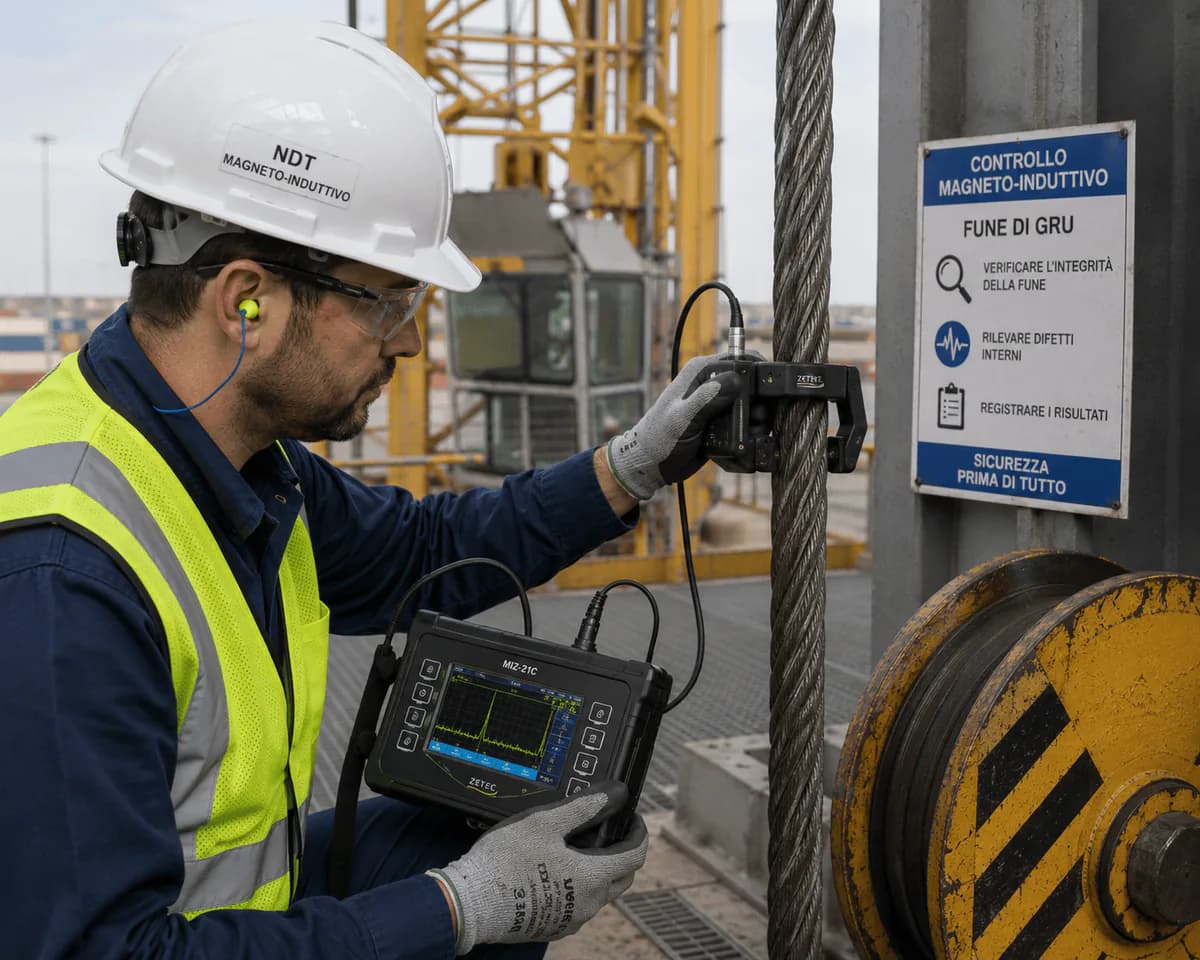
Electromagnetic inspection of steel wire ropes to detect internal and external wire breaks, corrosion, abrasion, and deformations. Non-destructive method that assesses rope condition without interrupting operations.
Technical scope
01
02
03
Technical evidence
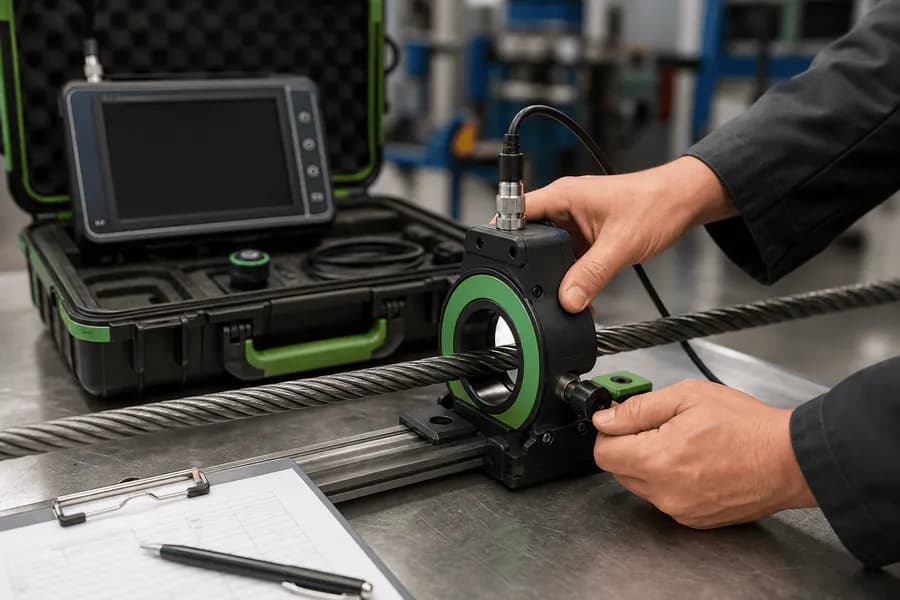
Portable instrumentation for elevated work
Real-time analysis with dedicated software
Report with trace, findings, and outcome summary
When use, condition, or applicable rules call for a targeted inspection.
Components, markings, condition, and function are checked with the applicable method.
Results, evidence, and follow-up stay connected to the equipment in Cruscotto™.
Technical appendix
The complete tables remain available to prepare the work and share inspection criteria.
UNI ISO 4309:2019 - Wire ropes inspection, maintenance, and discard · EN 1677-1 - Forged components for slings, grade 8 · EN 1677-2 - Hooks with latch, grade 8 · EN 1677-3 - Self-locking hooks, grade 8 · EN 1677-4 - Master links, grade 8
| Check | Method | Acceptance criterion | Reference standard |
|---|---|---|---|
| Identification tag | Visual | Present, readable, data consistent with CE certificate | UNI ISO 4309:2019 |
| Rope surface condition | Visual | Intact surface, no deep corrosion or covering paint | UNI ISO 4309:2019 |
| Broken wires | Visual | Broken wires within limits defined by the standard for the rope construction | UNI ISO 4309:2019 |
| Permanent deformation | Visual | No birdcaging, bottleneck deformation, or rigid kinks | UNI ISO 4309:2019 |
| Suspension ring wear | Caliper | Thickness reduction <10% compared with original | EN 1677-4 |
| Accessory assembly | Visual | Components correctly mounted, with no play or defects | EN 1677-1 |
| Terminal accessory integrity | Visual | No cracks, crushing, notches, or abusive markings | EN 1677-2 / EN 1677-3 |
| Terminal hook wear | Caliper | Thickness reduction <10% and regular geometry | EN 1677-2 / EN 1677-3 |
| Locking system function | Visual | Automatic closure working, without friction or excessive play | EN 1677-2 / EN 1677-3 |
| Bolts, nuts, shackles | Visual + caliper | Intact threads, tightened components, no evident wear | EN 1677-1 |
Inspection outcome
Cruscotto™
The result, documents, useful images, and follow-up form a searchable history for each piece of equipment.
Applicable references
Complete references remain available without interrupting the operational reading of the record.
Scope boundaries
The method detects only discontinuities compatible with the material, preparation, and physical inspection principle. Doubts or out-of-scope indications require a complementary method or specialist assessment.
Clarify scope, indicative timing, registers, reports, and equipment traceability before planning the campaign.